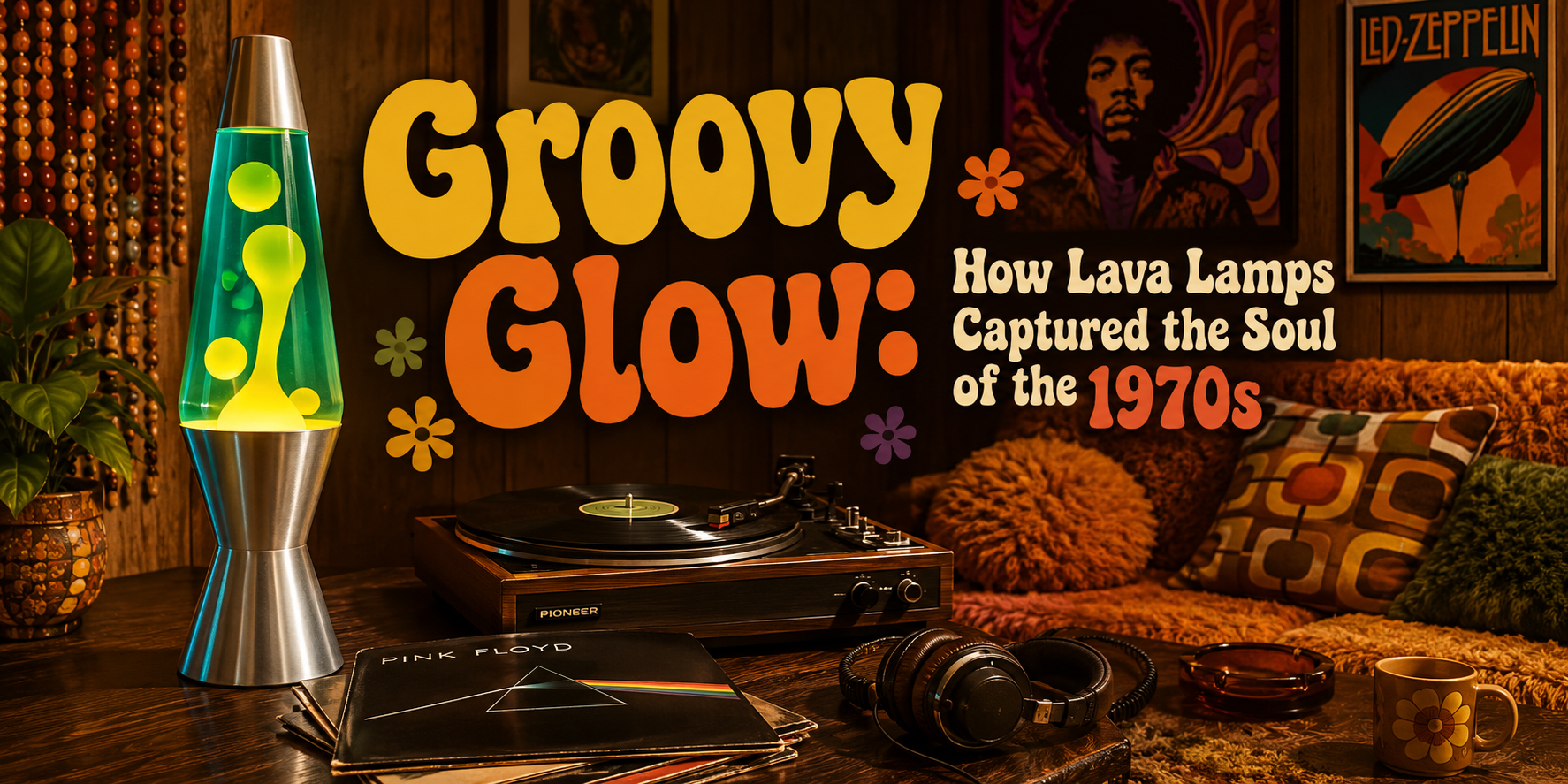
Groovy Glow: How Lava Lamps Captured the Soul of the 1970s
The 1970s were a decade of profound transition. Sandwiched between the revolutionary idealism of the late '60s and the slick, digital consumerism of the '80s, the '70s were a melting pot of counterculture going mainstream, disco beats, and interior design that wasn’t afraid to get a little weird.
And nothing anchored a '70s living room quite like the slow, hypnotic, otherworldly ooze of a lava lamp.
If you walked into a teenager's bedroom, a college dorm, or a bachelor pad in 1975, chances are you’d find one casting a warm, colorful glow in the corner. But how did this bizarre British invention become the ultimate symbol of American '70s decor?
The Birth of the Liquid Motion
Though we associate them heavily with the 1970s, the lava lamp was actually invented in 1963 by a British accountant named Edward Craven Walker. Inspired by a homemade egg timer he saw in a pub—which used a glass cocktail shaker and a blob of wax—Walker spent years perfecting the formula. He marketed it in the UK as the "Astro Lamp."
By the late 1960s, two American entrepreneurs bought the US manufacturing rights and spun up Lava Lite. While the psychedelic '60s gave the lamp its initial push, it was the 1970s that turned it into a certified pop-culture phenomenon.
Why the '70s Fell in Love with the Ooze
The 1970s were all about texture, warmth, and a distinct rejection of the sterile, mid-century modern aesthetic. Homes were filled with shag carpeting, wood paneling, and earthy tones like harvest gold and avocado green. The lava lamp fit right in, acting as a piece of living, kinetic art.
1. The Ultimate Chill-Out Companion
The '70s introduced a more relaxed, conversational style of socializing. People didn't just sit rigidly on couches; they lounged on giant floor cushions and beanbag chairs. In a dimly lit room, the rhythmic rising and falling of the wax provided the perfect backdrop for listening to vinyl records—whether it was the progressive rock of Pink Floyd or the smooth grooves of Marvin Gaye. It was ambient lighting before "ambience" was a marketing buzzword.
2. High-Tech Meets Low-Fi
In an era fascinated by the Space Age but increasingly skeptical of technology (thanks to the Cold War), the lava lamp was a comforting paradox. It looked like rocket fuel or alien biology, yet its science was delightfully simple.
The magic relies entirely on density and temperature:
A incandescent lightbulb at the base heats a heavy wax mixture until it expands, becomes less dense than the surrounding liquid, and floats to the top. As it cools away from the heat source, it contracts, becomes denser, and sinks back down to start the cycle all over again.
The Colors of a Decade
While the original lamps featured fairly muted tones, the 1970s explosion brought a psychedelic rainbow into mass production. The most iconic combinations of the era included:
- The Classic:* Yellow wax in blue liquid (which cast a vibrant green glow).
- The Fireball:* Red or orange wax in yellow liquid, mimicking actual molten lava.
- The Moody:* Purple liquid with white or pink wax for a deeper, more mysterious vibe.
They were housed in sleek, metallic, rocket-shaped bases—often finished in brushed chrome or gold—that made them look like mini-monoliths of cool.
> Fun Fact:* At the peak of the 1970s craze, Lava Lite was churning out over two million lamps a year. They weren't just novelty items; they were a staple of American manufacturing.
The Fade-Out and the Legacy
As the 1970s gave way to the 1980s, tastes shifted. The earthy, organic, and slow-moving aesthetic was replaced by sharp neon, geometric lines, and the fast-paced energy of the MTV generation. Lava lamps were boxed up and sent to garage sales, replaced by neon signs and halogen lights.
But true icons never really die. The lava lamp saw a massive revival in the late '90s (thanks to '70s nostalgia and movies like Austin Powers), proving that its appeal is timeless.
Today, looking at a lava lamp is like looking through a time capsule. It reminds us of a decade that was a little slower, a lot weirder, and utterly unafraid to let its groove show.
Comments (0)
No comments yet. Be the first to share your thoughts.
Sign in in your browser to leave a comment.